Designing numerical simulation workflows, research software and data-intensive methods for large-scale nuclear physics calculations, parameter estimation and model validation. Physical models and measurements produce uncertain data, and data-driven modelling, machine learning and data engineering turn them into reliable predictions.
Data Engineering
Employee Sports Benefits Data Platform
Data engineering · ETL · Workflow orchestration
Case study set by the programme.
Problem: In the case study, a company wanted to test the feasibility of two employee benefits and to estimate their financial impact.
Approach: An end-to-end pipeline that loads and validates HR and activity data, orchestrates the workflow, posts activities to Slack and presents indicators on a dashboard.
Technical implementation: Airflow DAGs orchestrate the workflow, with a PostgreSQL store, Superset dashboards and numbered Bash scripts as a manual fallback, all containerised with Docker Compose. The data are simulated employee and activity data (161 employees).
Validation: Data-quality checks run in the pipeline, and commute distances are validated with the Google Maps Distance Matrix API.
Outcome: A proof of concept; activity data is simulated, not read from a live service.
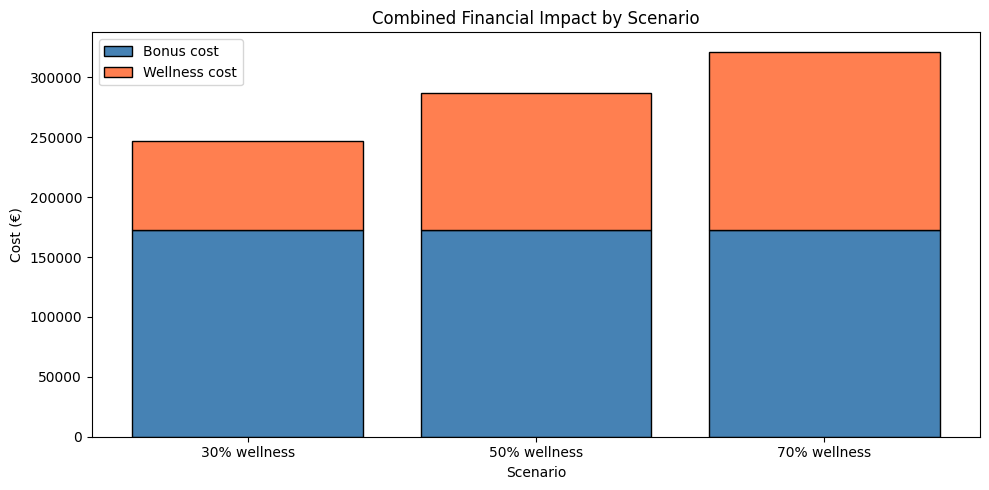
Combined financial impact of the two benefits under three wellness scenarios, from the financial impact notebook. Source
Problem: In the case study, a healthcare provider with scalability problems needed its medical records migrated from a CSV file to MongoDB.
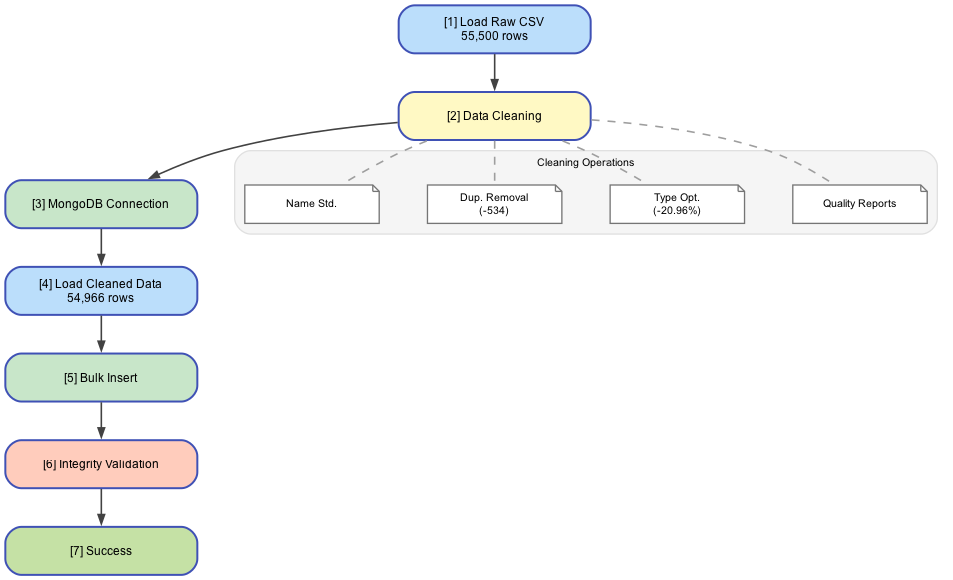
Approach: A seven-step ETL workflow with automated cleaning and integrity testing, a containerised deployment, and a written study of cloud deployment options on AWS.
Technical implementation: Name standardisation and duplicate removal, and memory use reduced by 21% through categorical and datetime types. Built with Python, pandas, PyMongo, MongoDB, Docker, pytest and Poetry.
Validation: Five integrity tests pass under pytest. 54,966 medical records remain after cleaning (55,500 in the source file).
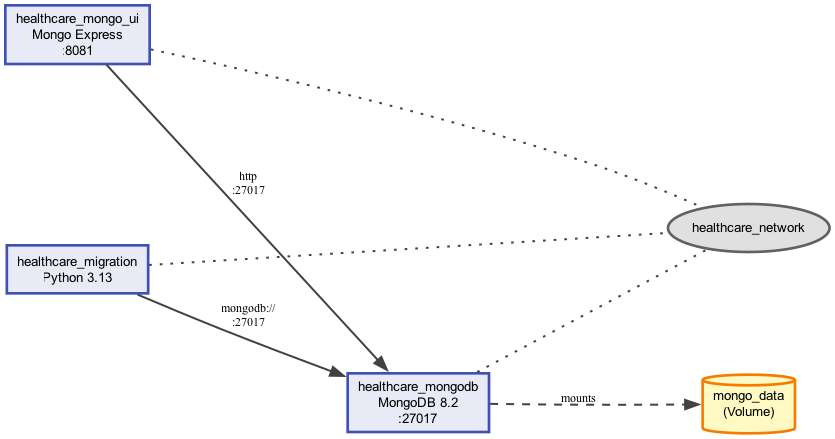
Outcome: A Docker Compose deployment of MongoDB with a web interface for the database, and an AWS comparison of DocumentDB, Atlas, EC2 and ECS.
ETL pipeline flow, from the repository documentation. SourceDocker infrastructure, from the repository documentation. Source
Problem: Recommending cultural events in Paris so that answers are grounded in real listings rather than in the general knowledge of a language model.
Approach: A retrieval-augmented generation proof of concept using live Open Agenda data. Events are fetched from the Open Agenda API, cleaned and filtered to the past 12 months in the Paris region, with one text chunk per event, embedded and indexed for similarity search.
Technical implementation: A single LangChain chain serves both the Streamlit chatbot and the evaluation, with Mistral AI and FAISS. Built with Python, LangChain, Mistral AI, FAISS, Streamlit, RAGAS, pytest and Poetry.
Validation: Evaluation with RAGAS on 30 questions, and 25 automated pytest tests.
Outcome: A proof of concept: single-turn, one data source, manual rebuilds.
RAG pipeline from event data to answer generation, from the repository notebooks. Source
Data analysis · Statistical analysis · Visualisation
Case study set by the programme.
Problem: Judging whether World Bank EdStats data can support the international expansion of an online education service for high school and university learners.
Approach: Exploration, cleaning and analysis of the five EdStats tables (indicator values, series catalogue, country metadata, country-series links, footnotes), downloaded separately from the World Bank and not included in the repository.
Technical implementation: Three Jupyter notebooks, using pandas, Matplotlib, Seaborn, Plotly and SciPy.
Validation: The indicators are assessed for relevance, completeness and reliability.
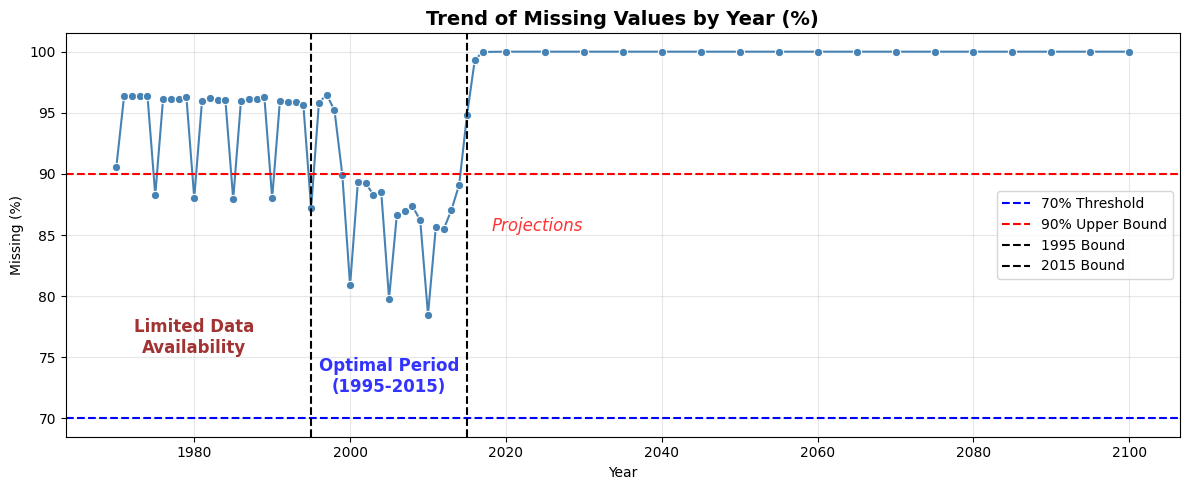
Share of missing values by year in the education indicators, from the analysis notebook. Source
Joint Master's in Nuclear Physics (Erasmus Mundus), 2018 to 2020, including the Erasmus+ course Data Analysis and Machine Learning: statistical analysis and optimisation, regression and classification, neural networks and decision trees. Course material.
OpenClassrooms, Data and Machine Learning Engineering, Level 7 (Bac+5), RNCP 39775, 2025 to 2026.