Research

What do I investigate?

Nuclear Reaction Dynamics and the Formation of Heavy and Superheavy Nuclei

How are heavy and superheavy nuclei formed, and how reliably can their production be predicted?

My research investigates the reaction mechanisms governing the formation of heavy and superheavy nuclei. I use stochastic reaction dynamics, numerical simulation and uncertainty quantification to understand and improve predictive modelling of fusion and evaporation processes.

Research Questions

Why does it matter?

The central challenge

Superheavy-element synthesis lies at the intersection of nuclear structure, reaction dynamics and quantum many-body physics.

The challenge is to understand why some heavy-ion collisions produce a new nucleus while most result in quasifission or fission. Reliable predictions are essential for guiding experiments aimed at discovering elements beyond Z = 118 and exploring the predicted island of stability.

  • How heavy can matter become?
  • Where does the periodic table end?
  • How do touching nuclei evolve toward fusion rather than quasifission?
  • Can production cross sections for new elements be reliably predicted?
  • Do our theories remain predictive at the limits of nuclear stability?
KEWPIE3 →

Short answers

How heavy can matter become?

This is not yet known. The heaviest element made is oganesson (Z = 118), and searches for elements 119 and 120 have found nothing so far. Models predict about 6,500 to 8,500 bound nuclei, with half-life predictions differing by up to 11 orders of magnitude.

Where does the periodic table end?

No fixed end is known. At Z ≈ 171 the 1s electron level enters the negative-energy continuum, which calls for new mathematics and does not mark the end of the elements. Periodicity breaks down earlier: some elements beyond 120 have no clear place in the table.

Do our theories remain predictive at the limits of nuclear stability?

Common approximations fail at the edge. Relativistic and quantum-electrodynamic effects grow strongly with Z, and nuclear predictions there are extrapolations, so reliable conclusions require Bayesian uncertainty quantification.

Why It Matters

Superheavy nuclei exist only because quantum shell effects counteract enormous Coulomb repulsion between protons.

Their study addresses the fundamental questions listed under Research Questions.

Research Vision

To develop predictive theories of nuclear reactions that guide the discovery of new elements and reveal the ultimate limits of the periodic table.

Nuclear Reaction Dynamics

What physics do I study?

Research Programme

My research focuses on the theoretical description of fusion–evaporation reactions leading to heavy and superheavy nuclei.

Nuclear Reaction Dynamics

Reaction mechanisms governing the evolution of colliding nuclei towards compound-nucleus formation.

Heavy and Superheavy Element Synthesis

Theoretical modelling of production cross sections and reaction pathways for heavy and superheavy nuclei.

Fusion–Evaporation Modelling

Computational modelling of capture, compound-nucleus formation and survival in fusion–evaporation reactions.

Key Equation

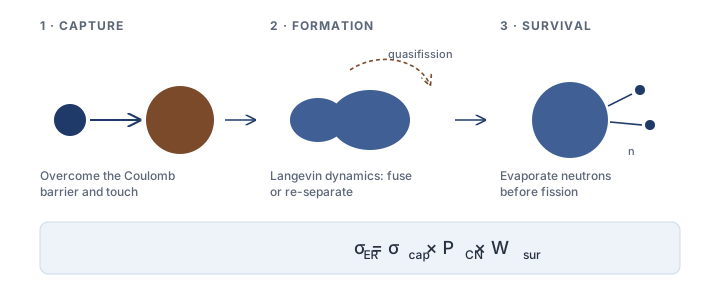
σER=σcap×PCN×Wsur\sigma_{\mathrm{ER}} = \sigma_{\mathrm{cap}} \times P_{\mathrm{CN}} \times W_{\mathrm{sur}}

Capture × Formation × Survival = New Element

The synthesis probability is determined by three competing processes: capture, compound-nucleus formation and survival against fission.

Schematic of superheavy-element synthesis in three stages: capture, compound-nucleus formation and survival. The evaporation-residue cross section is the product of the three.
Superheavy-element synthesis as three stages: capture, formation and survival.

Reaction Dynamics in Detail

Uncertainty Quantification

How do I establish predictive reliability?

  • Stochastic dynamics
  • Scientific computing
  • Uncertainty quantification
  • Bayesian optimisation

Uncertainty Quantification

Constraining reaction models using experimental data, statistical inference and sensitivity analysis to quantify predictive confidence and identify the most influential physical parameters.

Current interests

  • Formation mechanisms of superheavy nuclei
  • Fusion-quasifission competition
  • Shell effects in heavy and superheavy systems
  • Evaporation-residue cross-section predictions
  • Statistical model calibration
  • Bayesian uncertainty quantification
  • Physics-informed machine learning
  • High-performance scientific computing

Research Contributions

  • Modelling fusion and quasifission dynamics in heavy-ion collisions
  • Calibration of reaction models against experimental data
  • Uncertainty-aware predictions of superheavy-element production cross sections
  • Development and application of KEWPIE-based reaction simulations
  • Research software for numerical simulation of reaction dynamics and model validation

Earlier Research

The BSc, MSc and PhD research is set out in chronological order on a separate page. Earlier Research →

Publications

Selected and complete publication records are available on the publications page.

View publications →